‘Bring our girls back’…Nigeria

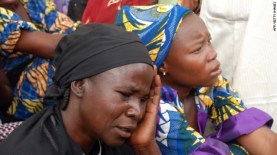
140509175847-nigeria-mothers-story-topI can hardly find words to describe my distress regarding the situation in North Eastern Nigeria. Two hundred and thirty young girls taken / kidnapped by ‘Boko Haram’ from their  school in Chibok. ‘Boko Haram’ apparently stands for ‘western education is forbidden’. So it seems that the young girls seeking education were targeted for just that, accessing education. We all know that education changes how we think and view our lives and our cultures. Fear of potential cultural change (loss of male power) drives radical groups like ‘Boko Haram’ to take extreme and barbaric action.

Can’t imagine the anguish that the parents and families are going through…to have  a child taken by a group of rebels and to not know what is happening to your child must be some kind of ‘living hell’. Now, I don’t want to comment on matters of Nigerian culture that I know very little about but I do want to comment on human rights. No-one, regardless of their beliefs, has the right to impose their own beliefs (misguided as they sound to us) on others in barbaric and inhumane terms. And that’s what this act in Nigeria is.

The other aspect to this appalling story is that these abductions are not rare, they apparently happen often to girls, very young girls, who are taken from their homes and villages, sold off for marriage or sex trading and are never seen again.

The issue of gender in some cultures (most cultures come to think about it) is a very complicated one and requires a lot of understanding. However, regardless of attitudes toward roles and functions of women and men in our society (and in some cultural groups)this behaviour is nothing but an outrage that the rest of the world must take action against.

How do we take action, how do we help most, how do we make a difference? These questions have rolled around in my head for the last few weeks. Strangely, or not so strangely I have felt nothing but a numb dis-empowerment since hearing about this latest malfunction of humanity.

As an older woman who has the fortune to live in a country where women mostly have a voice, not that it’s perfect but we are able to rally and speak out and address issues with a certain level of confidence compared to our sisters in Nigeria, I despair…! But, that’s not enough, we have to take action. This is the first part of my action…speaking about it.

Posted in Education, Life, People, Relationships, Uncategorized | Tagged , , , , , , , | 4 Comments

Knitting…more than just a ‘Nana’ skill…

francoise-duparcwomanknitting

Today I had a very grounded conversation with a good friend. We talked about knitting. My friend had come to stay overnight and as it happened she brought her knitting. Now, neither of us proclaim to be super knitters but we come from families where our mothers and grandmothers knitted and knitted very well. We discussed her current project…the makings of a beautiful wrap in charcoal Italian wool. It seems there had been a couple of false starts with this piece, I suspect it may have started out with a different intention, however, after a chat and a good look at the progress it was decided that the shawl would proceed and perhaps a fringe could be added.

We talked of our Mother’s skills as we sat in the autumn sunshine. My friends Mother was particularly skilled in not just knitting but in many other fine and delicate needlework modalities. My Mum had knitted all of her life, as had her Mother. Mum knitted like many other women of her era, for pleasure and as a way of clothing her children and family. I remember as a child having at least one new cardigan or jumper each year to match a new pleated skirt. It was (still is) also known that knitted and well cared for garments could stand the test of time and be handed down to child after child or from family to family. I have two knitted jumpers that are over twenty years old, they are not ‘old hat’ just not worn out and one of them has travelled overseas with me many times.

A couple of years ago after a couple of health problems I knitted my husband and son a jumper each. I remember feeling the thrill of knowing that I was using time in a valuable and meaningful manner. I also recalled the connectedness to something that was hard to explain. It sounds a bit strange now but at the time the process of knitting jumpers for my family members was particularly therapeutic.

When I pick up my knitting (not that I knit as much as I would like to) I immediately feel a kinship to all other women who knit, especially the women in my family who taught me to do so. Knitting is often joked about as an old women’s hobby or something people take up when they can no longer manage to do anything else. I have to dispute that notion, one can only knit if they know how to knit. Okay, it’s possible to learn to knit later in life but I suspect it’s not easy to become comfortable and proficient to a point where it’s enjoyable and can be used as relaxation. Coming to knitting late in life might be akin to learning to swim or ride a bike as an adult having never done so as a child, the natural comfort isn’t quite present, I suspect. I stand to be corrected around this issue but there is something profoundly fascinating and satisfying about the feel of a knitting needle in each hand and the yarn wrapped around the index finger…and having an intuitive almost innate reflex to both. I have a strong hunch that this response comes from years of knitting and the primary act of learning to knit from a trusted adult.

What is also interesting to me is the fact that I know many women who knit, work in a range of professional careers, raise families, conduct relationships, and generally live busy and active lives. So, I want to debunk right away the subtle innuendo that knitting is somehow a tad pedestrian and mundane. Women from all walks of life and ages knit (so do some men) and value the tradition of the predominately female skill that unites a sisterhood of knitters across the globe…

6a00d8345cfee069e201287719382f970c-320wi

Posted in Education, Life, People, Relationships, Uncategorized | Tagged , , , , , | Leave a comment

It’s all about me . . . or is it?

Sometimes I want to avoid conversations with other people my age. I’m sixty-three and all but retired (sorry Mr Abbott, I’m obviously lazy but I’ll try not to cost you anything…). I don’t always want to talk about the best place in town to eat or have a conversation about the weather and how it’s annoying or not perfect for golf or for gardening or whatever. Now, not that I don’t complain about the weather, I do, but it’s boring and I’m trying to keep my mouth shut and just get on with it.

On a more serious note however, I’ve been observing what happens to people when they retire or when at least they have more time on their hands. Sure, when we get older we can slow down a bit and unfortunately for some folk, illness might be part of the equation as well. However, for many people my age it’s a time of travel (depending on a few things, money being one of them…) and socializing to fill in the time. And, that’s the bit that is starting to bore me terribly. People will inquire, ‘planning any trips this year’? I guess this is fair enough as we have travelled a bit over the years, tracing family heritage and researching for writing (good excuses). Now you might say, ‘well isn’t that just luxury or filling in time?’ Yes, you are right it has been a luxury and that’s what I’m starting to challenge.

We (us fifty, sixty and seventy year olds) can’t continuously take holidays and seek self-gratification for ever, can we? Don’t we have to be useful members of society and contribute or put something back occasionally. Well that’s where I’m up to right now. It isn’t an easy position to take because it puts a level of responsibility right back on my ever stooping shoulders. Now I’m not saying we shouldn’t have fun or take time for travel, of course we should, but it’s the pursuit of leaving behind any responsibility of work, (not all work is paid employment) community and the needs of others around us that saddens and worries me.

Of course not all of us want to do volunteer work that is of little interest to us. I know some people who volunteer and carry out tasks for all sorts of community organisations and see it as ‘doing their bit’ but not really enjoying it, an obligation perhaps.  I would much prefer to be engaged in an activity or cause that I believe in or feel that I at least have something to offer. So, a very real dilemma exists around being actively engaged in worthwhile and satisfying ‘work’ as opposed to just doing your bit because you think you should. It’s easy to understand then, why so many people seek self full-filling social and entertainment opportunities as a way of feeling active and happy.

However, there are many examples of people who refuse to join in the ‘retired’ syndrome of adjusting to no work, all play mentality. They take on family responsibilities like childcare for grandchildren or look after older folk, they set up small business opportunities, they study university courses (if they can afford it…), they teach in their area of expertise, they join and really contribute to community groups, they look after a sick neighbour, they worry about the kids across the road, they visit relatives and give a hand, they join political parties and have a voice . . . a real voice not just a whinge, they work with the disadvantaged and after all of this they sleep well at the end of the day and don’t have time to think about themselves and what they will do tomorrow. . . I want to be one of these people, I’m working on it but it’s not as easy as it sounds.

First of all, to be an active contributor I think you need to think long and hard about capacity. There is probably a need to have a balance and not over do the active contributor role, better to keep it happening than to burn out with over enthusiasm Besides when we take on new responsibilities we sort of have to explore and learn how to manage ourselves with our new roles. Often I suspect, the boundaries of engagement take a while to become evident.

A couple of years ago I decided to become politically active. I tired of mumbling at the television set or complaining to friends about government policy and felt dis-empowered in relation to what was happening in my own country. So after some soul-searching I joined (re-joined) a political party. Of course, it wasn’t long before I was asked to volunteer. I tentatively agreed and became a raw recruit. Luckily I was able to utilise some of my skills but still there was a learning curve to be navigated. I worked amongst younger and highly skilled people, I learnt from them and I like to think they picked up a few skills from me. Most of all I was in an active and stimulating environment.

Now I’m not suggesting that all people should join political parties, it’s just an example of an activity that enabled me to experience something that fitted with my values and ideas at the time. But, it taught me to do something that felt right. And unlike when I was working in paid work, I had the time to make it happen.

So now that I’m thinking more about these issues, particularly having blabbed about it on a blog…I have a real task ahead. Or perhaps instead (if it all gets too hard) I’ll fall into having too many lunches with friends, planning resort holidays, thinking about cruises on boats and checking the weather for the perfect day…forgive me if I do…or better still remind me that I wrote this!

Posted in Education, Life, People, Relationships, Uncategorized | Tagged , , , , , , , | 2 Comments

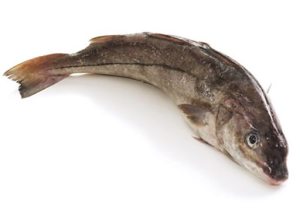
Smoked Cod (Finnan Haddie) and Egg Sauce…

When I was growing up (back in the dark dim…) every Good Friday we sat down to a lunch of smoked cod and egg sauce. It was the only time in the year that we had it, a bit like Christmas pudding. My mother and her mother from Scottish roots served the traditional smoked cod called finnan haddie, with egg sauce and we loved it.  Now I’m not so sure many people still do this, I think some of my aunts might. We don’t because my husband has long refused to have anything to do with smoked cod and egg sauce, even once a year was is too much for him…

In my husband’s family there was no such tradition of smoked cod and egg sauce on Good Friday. They were practising Catholics with Irish ancestry so they certainly ate fish on Fridays but not the ‘disgusting smoked cod stuff’…  Irish history tells us that the Holy Week leading to Easter and including Good Friday was harsh with food denial rules, no way a wee bit of smoked cod and egg sauce would get a run… And so, over the years I’ve relinquished the idea of having smoked cod in exchange for any fish or non-meat meal. I miss the tradition but I then I guess Good Friday is a sombre day so perhaps the meal is not important. However, some people would say that finnan haddie is perfect for such a solemn day…!

I know that other cultures have special food for particular days. My Italian friend is cooking baccala (a traditional Italian dish) and polenta for lunch. Every Good Friday her family has partaken of this food and they still carry the tradition forward. Easter is a very big food event for the Italians, or so I’m informed but then the Italians do love their food and do it well.

Makes me think about food traditions, how they are reinforced and passed on and how easily they can be lost. It seems that once a habit is broken it’s unlikely to be reinstated as we all know that some food tastes and ideas are developed from the crib. Sometimes, of course traditions are altered along the way and I think that’s fine. I’m hoping next year to persuade one of my sons (who happens to be a very good chef) to join me in cooking and eating finnan haddie and egg sauce on Good Friday (a little attempt at reinstatement). I don’t think my other son will be too worried (big smile if he reads this) as he happens to be a vegetarian…so much for tradition…

finnan haddie

Posted in Education, Life, People, Relationships, Uncategorized | Tagged , , , , , | 8 Comments

‘Questions of Travel’ . . .

I’ve been reading the Miles Franklin Literary Award winning book for 2013 written by Michelle de Krester called ‘Questions of Travel’. Many cups of coffee later I’ve arrived at the end of this magnificent but daunting five hundred page plus read.

A double narrative, the book follows the travels and life experiences of two people.  Laura and Ravi, two separate lives from different places cross paths in a way that teases the reader into developing a readers plot . . . but no, this book twists and turns and never allows for predictability.

The characters are a contrast both circumstantial and culturally.  Ravi, traumatized from the death of his wife and child in Sri-Lanka is depicted as a gentle soul who elicits sympathy from the reader. He’s an interesting character who views Sydney and Australia through the lens of a refugee. Laura, is not so kindly dealt with in my opinion, after an unhappy childhood she blunders her way through the world and is depicted in a rather brash manner.  de Krester paints Laura as large and ugly but a somewhat humourous Australian. This raises for me the issues of cultural perspectives and how the characters in this book appear to act primarily as vehicles for the exploration of underlying cultural subtleties and perhaps biases (this might be a little harsh).

I heard an interview with de Krester and she talked about the book being about identity, contemporary life and travel, she went on to comment that modern age is the age of travel. This made me think about the actual question of why we travel. What is travel if it is not a means to an end . . . why do we move or seek to move away from the familiar (often to return at a later time in life) to the unknown? Is the unknown an extension of self or is the need to extend beyond self actually a limitation of our identity? Is the author suggesting, I think she may be, that travel is now universal. But is it? Interestingly in one of her interviews, de Krester talks about the global rich (those who travel) and the global poor (those who do not travel). Feels a bit like a contradiction. . .

Anyway, more about my reading experience. This was a book that was impossible (for me) to read quickly and it certainly isn’t a skim read because tucked into a line or between a few well-chosen words a little something dances. . . a nuance that allows the narrative to eventually come together (in my humble view).

I like and dislike the way the author does not attempt to explain or carry the reader along . . . it’s as if the choice to follow the narrative and what to make of it is entirely up to the reader . . . Now I am going to ‘stick my neck out’ here. Michelle de Krester is no doubt a brilliant writer, after all not many writers win the Miles Franklin . . . but I find her style to be a tad aloof, there I’ve said it . . . It could be that she is enormously complimentary and assumes we are all as competent (in a literary sense that is) as she is.

The joy of this book for me, is that it’s made me think long and hard about world situations, people’s lives, cultural differences and similarities, not so much about travel. So if the measure of a good book is to leave the reader thinking well after the last page (and writing blogs). . . then this book ticks all of the boxes . . .

Posted in Education, Life, People, Relationships, Uncategorized | Tagged , , , , , , , , , , | 4 Comments

When a child never returns . . .

What happens when a person or family experiences a loss so unfathomable, distressing and profound that they cannot make sense of? I’m talking about when a child goes missing and never returns? How does a family cope when sentenced to disenfranchised grief forever, a life-long uncertainty that hovers in the background always. When does a family move from the frantic and crisis driven head-space, when it is discovered that their child is missing, to the appalling realisation and question of  ‘what if he or she is never found?’ And then, if that’s not enough, having to actually continue some resemblance of a functioning life for the well-being of the lost child’s siblings.

We have all read about children who mysteriously go missing. Abduction. When the alarm is first given there is usually great concern and worry but mostly, I think, we expect the child to be found. As a community we hold hope, we wait until authorities do what they are good at, solve the mystery, find the child or children and the perpetrators/s. There are however, some rare circumstances when children disappear and are never found. Often fresh clues result in false hope of finding the child or their remains. Over time (I suspect) the full extent of the tragedy is woven into the daily lives of the child’s family. I can’t begin to imagine the extent of pain and torment for parents and siblings when such circumstances occur. ‘Living hell’ are the only words that come to mind.

From time to time I’ve read about a young twelve-year-old boy who went missing from a Central Victorian town in 1975 and was never found. Until this day his younger brother, who was ten at the time, has never given up hope of finding the remains of his brother. He has diligently followed all clues and even when the police have been unable to continue due to lack of substantial information, the adult brother of the missing boy has continued his plight. It can’t be easy when the authorities run out of clues, the community starts to accept that it’s a mystery, extended family and friends perhaps give advice to move on and yet, sometimes moving on (whatever that means) is impossible . . .

The fact that a young boy was abducted and thought murdered is horrific, an unbearable situation. So too, I suspect are the lives that have been forced to live in a shadow as the result of the uncertainty of their son and brothers’ death.  Not to have a body to bury, mourn and visit on special occasions is surely an insufferable and life changing scenario for a family to endure.

And so back to the man who refuses to give up the search for his brother. How has he managed to pursue the truth for all of these years, refusing to accept that he will never know? Is this his way of mourning and honouring his big brother? I suspect it is. I find myself thinking about this man on his long, sad journey, seeking to find his brother and to rightfully bring him to a calm resting place.  I’ve never met this courageous person but I’m overwhelmed by his determination . . . I admire him enormously for doing what he knows he has to do.

Posted in Life, People, Relationships, Uncategorized | Tagged , , , , , , , | 3 Comments

So, you think you’ll write a novel . . .

booksWell, not much of a task is it? A novel, yep can’t be that hard, after all look around you, books everywhere. On the net, bookshops, garage sales, junk shops, libraries. Yes, it’s an epidemic, a bit common really. If all those other people in the world can write a book then anyone can. Especially you, because you fancy the idea of writing your own book.

You have a head full of ideas or better still, stories,  then surely you’re off and running . . . okay, perhaps not so fast, there are a few questions you might want to consider. Can you write? . . . it’s always a good starting position. Do you know much about the craft of writing and literature? Have you read anything about writing? Have you written shorter stories, essays or prose? What about courses or workshops, attended any by chance? Now don’t let me dampen your enthusiasm because often enthusiasm is all we’ve got (at the start anyway). Despondency comes later.

Right, all of the boring bits aside, let’s start writing, can’t be hard. Remember everyone does it and didn’t you get smiley faces on your primary school stories. Yes, latent talent just waiting to jump out and create the next best seller. Off we go then.  No, don’t worry about the story plan, it’s in your head. Structure . . . hm. Characterisation . . . no problems here, people are easy. Point of view, well yes, it’s my book so it’s my point of view . . .? Voice and dialogue . . . can’t be too hard, I have a good imagination. Description, landscape, background, research, time and place, historical research, style, authenticity, scope, method, all there to confuse the newcomer on the block and maybe protect the complicated and sophisticated world of writing. No, don’t be deterred, push on, ignorance is bliss, so they say . . .

Okay, first chapter a breeze, a cracker opening. This book is going somewhere (probably the bin but no one is going to be that unkind at this stage). Second and third chapters bounding along, not that the plot has advanced too far, never mind . . .  no, don’t get caught up with that academic stuff, it’s your book and you can write it the way you golly well want. Don’t you love the people who have danced out of your head and onto your pages? Well, there’s a warning about falling in love with your own words / writing / characters . . . but that doesn’t probably apply to you because you know it’s really good . . . ish.

Seventy to eighty thousand words later, give or take a few chapters that fell by the wayside (not to mention the many other chapters that should have) you have a manuscript. There are a few too many characters, you can’t actually remember why some of them are there but at the time they just jumped in. Timelines are a bit of a problem. Long gaps that are unaccounted for, what were you thinking . . . The names of some the characters mysteriously change along the way, no worries this can be sorted along with the (unknown to you) grammatical and style errors. The ending is also a heart stopper but probably unbelievable. However, it is fiction isn’t it?

Apart from the exhaustion that settles over the eager and enthusiastic writer after a first draft is completed, the realisation that it’s probably not a best seller (but always remain optimistic . . .) sets in. So too, does the appreciation of how long it takes to turn out writing that is even moderately okay. It’s about at this stage when realistic writers and deflated newcomers run for knowledge, craft development and help! Of course if you still have a belief that your novel is about to be picked up (how I love fantasy . . .) by a publisher, go for it, good luck and let me know how you get on.

Meanwhile I’m back to tedious drafting and editing as well as reading amazing books written by established and proven writers. An analogy that comes to mind (in relation to my own writing) is one of a cyclist (an unfit one) peddling up a steep hill. The start is energetic with heightened levels of enthusiasm but as the climb continues the peddling slows and the puffing begins, then the pedals barely turn until the bike starts to wobble and the only thing left to do is put a foot on the ground to steady. Then on the bike again . . .  slower now,  the steep hill demands respect . . .

Posted in Education, Life, People | Tagged , , , , , , , | 3 Comments

Suddenly we are old . . .

We never think that we’ll age . . . well come on now be honest. As we hit our forties and fifties we are still (given good genes and good luck) very active and productive. But we do begin to say things like . . .oh, I must be getting old . . . ha, ha, ha . . . but actually it’s the furthest thing from our minds. Let’s face it, in your fifties you are still most likely working, planning holidays and making decisions about what to do next.

Then something else happens. You turn sixty. Well, that’s okay, I can hear you say, nothing wrong with being sixty. Right you are. But there is, I believe a distinct difference in turning sixty to that of turning fifty. Physically, as to be expected our bodies are not necessarily as good as they were ten years ago. Of course there will always be some people in their sixties that dispute this, that’s a good thing I say, let them stay positive . . . If believing that you are forever young and that your body doesn’t age is a helpful way to stay vital, then that’s fine . . .

But for most of us, if we are tuned in to our lives (and bodies) will find that there are differences to contend with. Small (sometimes large) health problems raise their ugly heads, annoying matters like joint problems, heart disorders and a range of other ailments that come with the territory. For some fortunate folk they never experience these problems along the way. Power to them I say, but most of us will have to humble ourselves and work through particular life advancement difficulties at some stage, even if it’s temporary. And it’s not always physical health issues,  it can be emotional and financial changes that can arrive on our doorstep at any time.

Now, whilst being sixty is not a worry for most of us, sometimes being seventy can come with a few challenges. Okay, I can hear the super seventy somethings saying, never felt better, what are you talking about? Well, I’m talking on behalf of a lot of folk who are not so chirpy and have to manage many difficulties in their life. It may not always their own health, it may be a spouse. There are many challenges to navigate as well as fantastic opportunities to enjoy with being older.

A few weeks back, a close relative who is in his very early seventies had a very serious scrape with a life-threatening health trauma. Surgery was successful and his return to health is excellent. However, whilst talking to him recently he relayed several stories about lifelong friends his same age. Three friends had all experienced difficult health issues. One friend actually died. My relative, pleased to be doing so well himself since his surgery, nodded his head as he spoke. He cheerily finished the conversation with. ‘And you know what’s so amazing? Suddenly we are old!’

One of the most wonderful things (in my view ) about older age is the wisdom of reflection, it’s a very powerful and wonderful experience. To be able to think about life in various ways, to feel that your opinion is based on some valid experience, to not only reflect the past but to be curious regarding the future, to have time to think clearly and not have to be constantly on the go is indeed a privilege only available in older age, I suspect.

Self reflection is available to all but in older age it becomes very important. Being able to spend time alone. Rejoicing in quiet activity and quiet time, taking joy in and valuing skills that are well honed without looking for distractions or things new things to do. I  know people who fill in every spare hour of the day with activities and seem unable to tolerate time alone. I often wonder what they are running from.  Old age maybe. . .?

Posted in Life, People, Relationships | Tagged , , , , | 4 Comments

A lovely neighbour. . .

Something sad has happened in my street. A lovely neighbour died yesterday. She was a mother, a sister, a daughter and special to many people. She wasn’t old enough to leave us; she still had life tasks to complete, like the growing up of her teenage daughter and reaping the rewards of all her hard work in the years to come. And she did work hard, she ran her own business and lived life very independently.

Several months ago I noticed my neighbour was wearing a head scarf and looking considerably thinner than usual. We waved to each other across the street and went about our business. I remember feeling distinctly unsettled by her appearance. She wasn’t well, not well at all.

I spoke to her as she sat on her verandah one sunny morning. She told me that she had terminal cancer and wasn’t given long to live. She was however, pleased that she had been able to manage her affairs, this was very important to her. She glowed with warmth when she spoke of her extended family and how much their support meant to her. She was philosophical about her situation and actually said that her journey through her health crisis has been a valuable experience.

Over the last couple of months, she has been very ill but managed to spend time with her devoted and loving family who have rallied around her and looked after her until the end of her life.

We have never been close friends, just good neighbours but we always had a chat whenever we crossed paths. We had some lovely conversations about travel and gardens and a few conversations about the extension she built onto her home a couple of years back.

As I write this I can see her house from my front window. There is no activity and a strange quietness has settled over the house and our street.  Another neighbour has commented on how sad our street feels.

Yes, our street is in quiet mourning as we grieve for our lovely neighbour.

Posted in Life, People, Relationships, Uncategorized | Tagged , , , , , , | 4 Comments

On Motherhood and Disability . . .

Last week I was fortunate to attend a writing / book event in Melbourne. Margaret Drabble appeared in person at the ‘Wheelers Centre’. I guess the tour was part of a promotion for her newest book called ‘The Pure Gold Baby’ released last year. Margaret Drabble has for years written a steady stream of fiction, non-fiction and short stories. In her many novels and books she explores issues of life, motherhood, place and relationships. Now a Dame, the grand woman of literature exudes intelligent, generosity, calmness and above all inspiration. Sensibly dressed and serene, she is I suspect, not someone who can be easily swayed or talked into a particular point of view. Her perfect English accent demands respect but holds a warmth that very few accomplished writers are able to manage.

The Pure Gold Baby’ deals with issues of motherhood and in Margaret’s own words (taken from an ABC Melbourne interview recently) ‘motherhood in the most difficult of circumstances, being a single mother in the sixties and having a child with special needs’. The book deals with the situation of an educated single mother who has a daughter to her university professor. The child is delightful but has limited educational opportunities due to disability. She will require mothering forever.

It’s tough to know that your child will require care and support for the entirety of his/her life. We often say that we worry about our adult children forever but there is a big difference between normal concern for well and independent children compared with children who have different and very special needs. I can’t quite imagine how it must be to know that one day, as a parent, you may not be around to ensure the appropriate care for your adult child. Margaret Drabble’s book raised these very real issues. What is it like to see other children grow and develop into independent adults and yet your own very child is forever dependant?

The book, in my view has a strong confronting theme about the role of mothers. Mothering is a condition that can be discussed in many ways. It is a topic that everyone has a view about and often vastly differing views. Motherhood is a state of being that one is never quite prepared for, and I suspect it is the adjustment and acceptance of the role, often under less than perfect circumstances, that makes all the difference.

Mothering is a mixed bag. It can depend a heap on how we were mothered ourselves as to how we mother our own offspring. Education (all types) helps, the broader exposure to different perspectives and ideas can be a distinct advantage, although not always. Without new information we fall back to what we know and for many of us it’s the way our own mothers mothered. All fine if conditions were good, parenting styles were satisfactory and the family was secure and functional. If these components or parts of them were not present our map for future parenting of our own children may well be flawed. And yet, when one becomes a mother there is a severe expectation that automatically all women are prepared. Because, after all motherhood is akin to sainthood, isn’t it?

There is no doubt that men feel and experience a great deal of pressure regarding fatherhood, a role that has changed significantly over the last few decades. (I’m getting nervous now, I can feel the quick sand beneath my feet deepen with each word that I write). Although an increasing number of men are primary caregivers and stay at home dads, the majority of primary caregivers and sole parents are still women. So, the motherhood dance continues to expect women to know the steps and to dance well. And if we get out of step or our children falter there seems to be a mass of mother judge’s out their waiting and ready to call the tune.

So, back to the theme of the book about the single Mum and her beautiful but special needs child. How does a mother (and father) cope when having to factor in all the different requirements and needs of a child who will be forever young of heart? How does a mother view her role when all around her she witnesses other mothers moving on (and sometimes struggling) with normal developmental stages of parenting? Does she see others who are able to leave behind some of the constant responsibility of being the main carer and wonder what that would be like? Yes, it must be a difficult course to chart. It appears that the expectations of motherhood are multiplied when a child with a disability is part of the family. Margaret Drabble in her wisdom allows these issues to be explored with honestly.

Posted in Education, Life, People, Relationships, Uncategorized | Tagged , , , , , , , | 4 Comments